Costs
Small business cost records: label each figure's source, scope and date before comparing
Learn how to label each small business cost figure by source, scope and date, store its evidence, and compare quotes by scope before treating any amount as a total.
What to take away
- Label every figure as an allowance, quote, invoice, payment or reported total before you compare it with anything.
- Keep scope and period in separate columns so a deposit never reads as a full project cost.
- Write a missing-details line instead of a total the source does not support.
- Store each amount with the document that proves it, including superseded quotes.
- End every note with a documented status and a named review trigger.
A cost note is only as good as the label on the figure. Strip the label and a deposit starts reading like a final price.
This is bookkeeping, not estimating. It keeps every dollar amount attached to the scope, date and conditions that gave it meaning.
Classify the figure before you write about it
"The job cost $20,000" can describe a quote, a deposit, an invoice or a payment. Each has a different source and a different level of certainty.
What it records
- Budget allowance
- A planned spend for a defined task
- Vendor quote
- The vendor's offer for stated work
- Deposit
- Money paid against a future invoice
- Invoice
- A bill for the work described
- Payment record
- A documented transaction
- Reported total
- A source's own summary
What it does not establish
- Budget allowance
- A final project cost
- Vendor quote
- A typical market price
- Deposit
- Work completed
- Invoice
- Independent proof of result
- Payment record
- A universal comparison figure
- Reported total
- Details the source does not give
Open the note with the label, not the amount. "A 2027 vendor quote for the stated electrical scope" tells a reader how to read the number that follows.
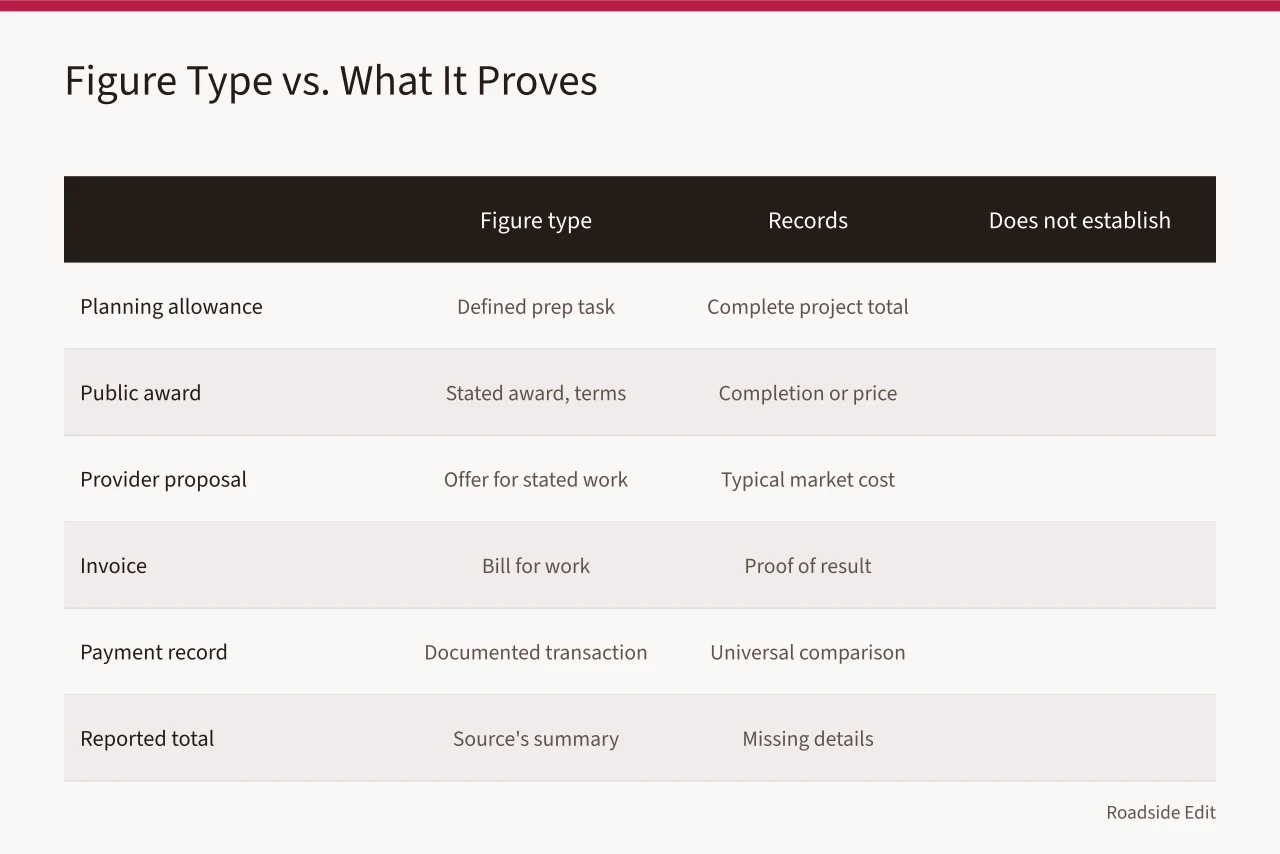
One useful principle is narrow: an amount carries the circumstances that give it meaning. The SBA guidance on managing business finances makes the same point about records that support a figure.
Keep scope and period in separate columns
One job can hold a quote, a deposit, a progress invoice and a final invoice. Each covers a different slice of the work.
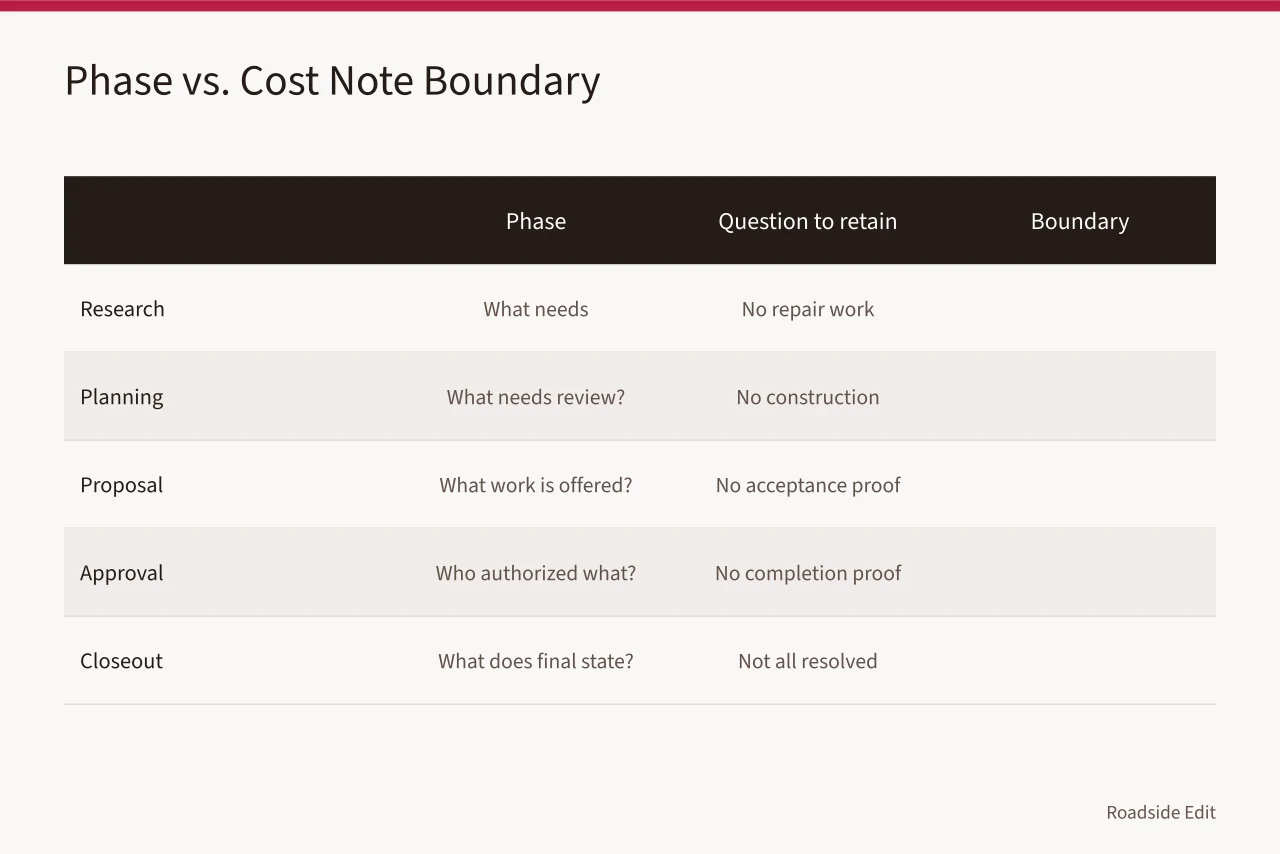
Question to retain
- Quote
- What work does the vendor offer?
- Deposit
- What was paid up front?
- Progress invoice
- What work is billed so far?
- Final invoice
- What does the closing bill state?
- Payment
- What cleared the bank?
Cost note boundary
- Quote
- Does not prove acceptance
- Deposit
- Does not prove completion
- Progress invoice
- Does not cover the remaining scope
- Final invoice
- Does not guarantee every defect is fixed
- Payment
- Does not match the invoice automatically
If a record says "sign restoration," do not expand it into roof, lighting or site work. If it says "deposit," do not describe it as the job total.
Use a missing-details line instead of a false total
Records omit what readers want most. A quote states a total but not access, disposal or permits. A bank line shows a payment but not the invoice behind it.
Write the gap down:
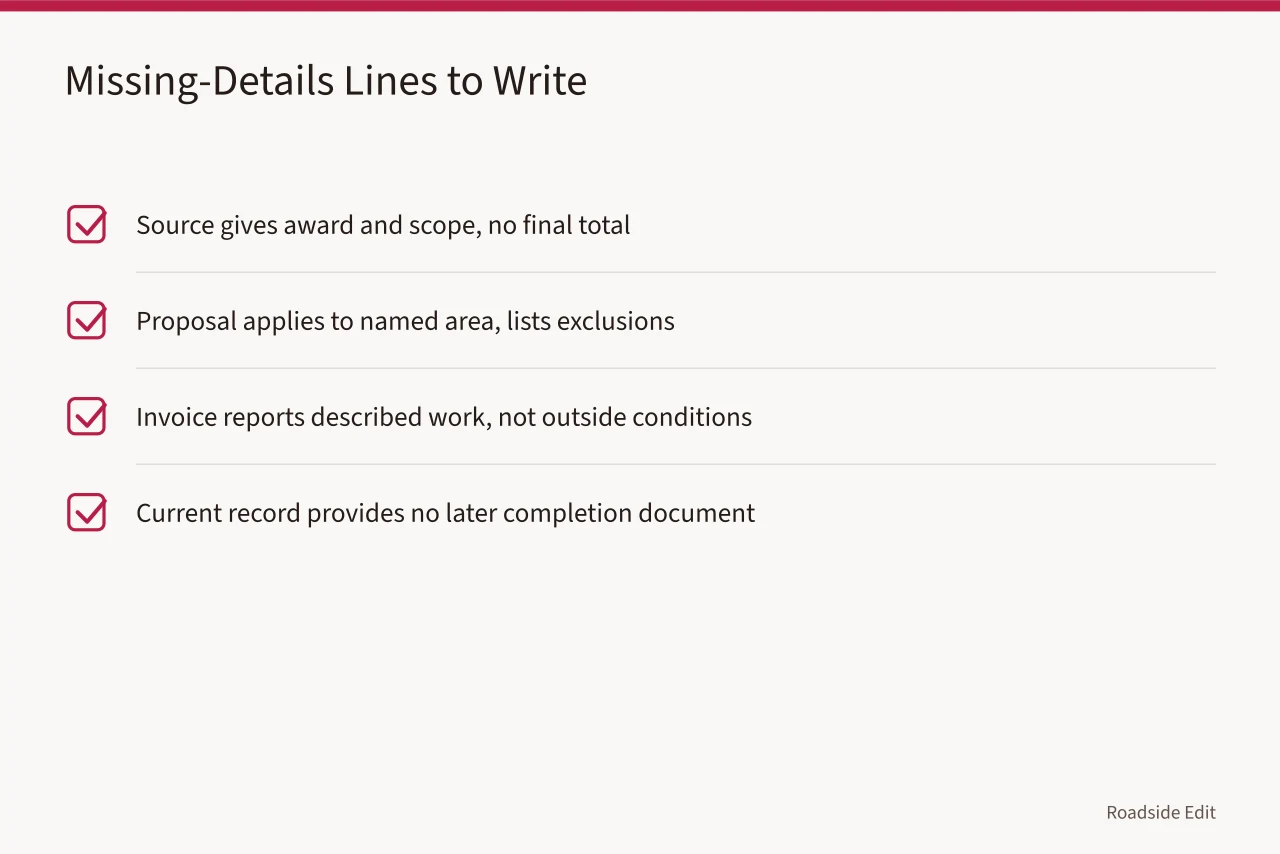
- "The vendor identifies the scope, but gives no final project total."
- "The quote applies to the named area and lists the stated exclusions."
- "The invoice reports the described work; it does not establish conditions outside that scope."
- "The current record does not provide a later completion document."
Each line hands the reader the next question without turning uncertainty into drama.
Keep a cost record with its evidence packet
A pasted amount is worthless to the next person who needs to check the scope. Store the direct source, the date shown, the claim, the stage and any condition attached to the figure.
The IRS Publication 583 sets out recordkeeping expectations for business bank records. The habit transfers: keep the quote, the revision and the closing invoice in one place.
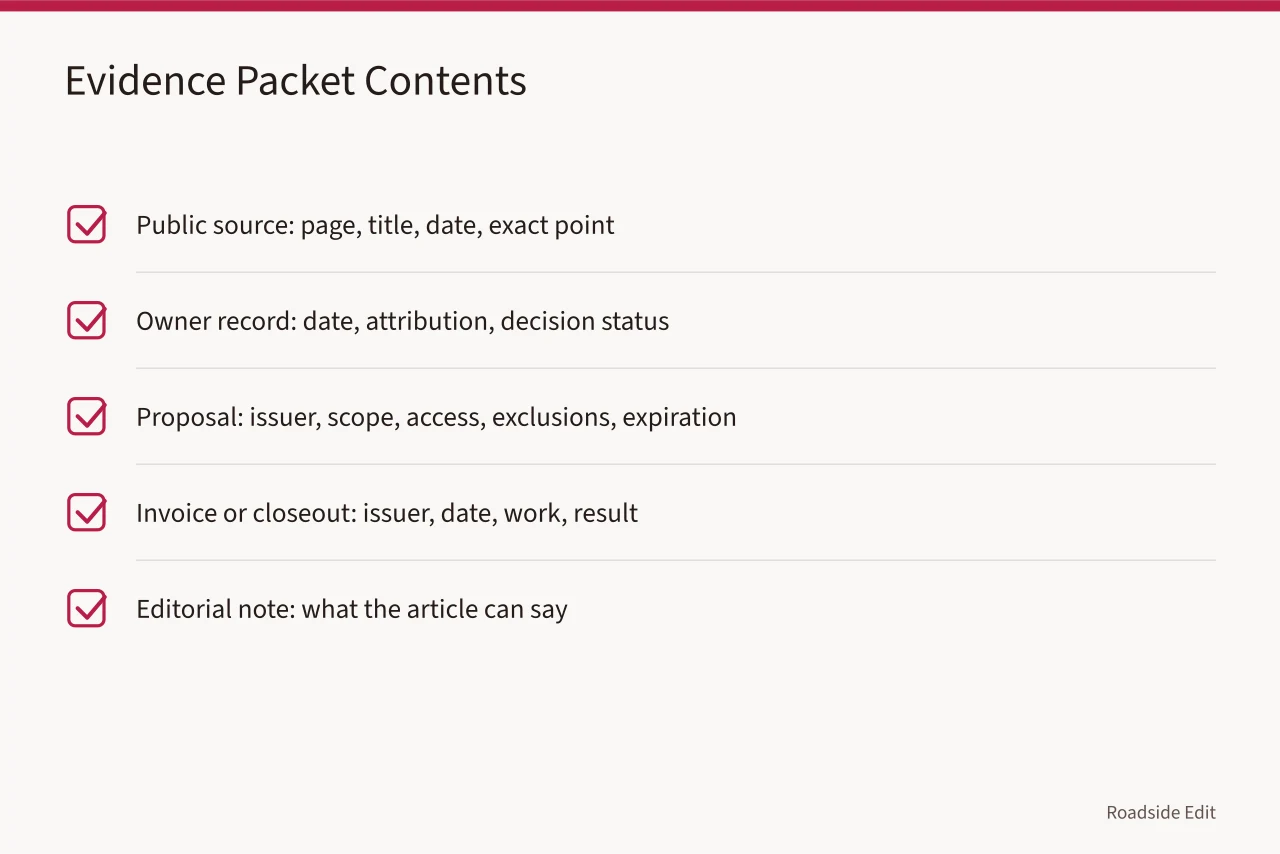
Evidence item / Keep this information
- Vendor quote
- Issuer, scope, access assumption, exclusions, expiration
- Owner record
- Date, attribution, decision status
- Invoice or closing bill
- Issuer, date, named work, stated result
- Editorial note
- What the note can and cannot say from the packet
When a vendor sends a revised quote, keep both versions. The change may expose a new assumption or a wider scope. That difference belongs in the file, and the pattern shows up in expense recording examples where six situations produce six different entries.
Compare quotes by words, not totals
Two quotes can land on similar prices and describe different work. One assumes ground-level access. Another includes equipment or a preliminary review.
Write one request before you compare anything: work area, visible facts, access conditions, requested outcome, known exclusions. Then read the responses field by field.
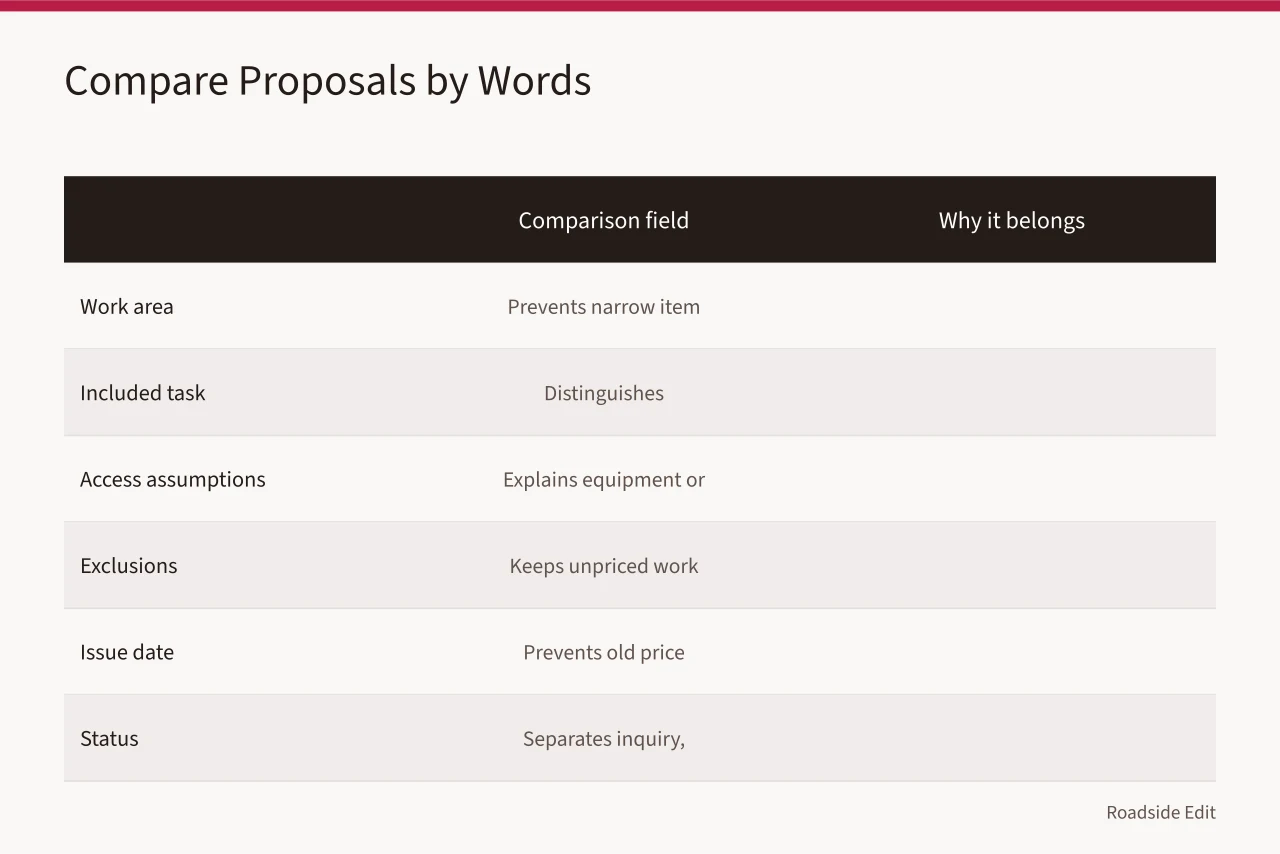
Comparison field / Why it belongs in the note
- Work area
- Prevents a narrow item from becoming a building-wide figure
- Included task
- Distinguishes inspection, maintenance and repair
- Access assumptions
- Explains equipment or labor differences
- Exclusions
- Keeps unpriced work visible
- Issue date
- Prevents an old price from appearing current
- Status
- Separates inquiry, quote, approval and closeout
If the quotes do not answer the same written request, do not average them. Revise the request or say the scopes cannot yet be compared. The same discipline sits behind accounts payable metrics that predict anything, where a single number rarely tells the story.
Keep vendor figures in their own lane
A vendor may supply a price, promote a service or buy a profile. That material can run in a note when it is attributed, dated and labeled. It must not read as a verified cost finding.
Log the business name, submission date, exact figure, scope, exclusions and sponsorship status. Publish a vendor figure as a vendor statement, never as an editorial average. If you compare vendors, say plainly that you are comparing the records they sent.
Close the cost note with status and review
Every note ends on a documented status. Pick one: quote received, deposit paid, work in progress or final invoice received. Another option is no later record found. Add a review trigger when the status is open, such as a new document, an owner decision or a dated future check.
Time passing does not make work complete, and a budget line does not either. A closeout claim needs a closeout record. If the only document is a quote, write quote. The same rule governs how you read expense recording metrics without fooling yourself.
Final cost-record check
- Is every figure labeled as an allowance, quote, deposit, invoice, payment or reported total?
- Does the note carry source, date, scope, stage, conditions and exclusions?
- Are missing details named rather than filled with assumptions?
- Are related cost documents stored against the same question?
- Do compared quotes answer the same written request?
The aim is not a larger spreadsheet. It is a record where each number can be checked and kept inside the limits of its source. Get the labels right and the chart of accounts framework has something solid to file against.
Common questions
Can a vendor quote be published as a current cost estimate?
No. It is an offer for the stated scope, date and terms. A current figure needs a current, defined scope.
Can two vendor totals be averaged?
Only once the documents describe the same work area, included task, access assumptions and exclusions. Until then the average hides the difference.
Does an invoice prove that all related work is complete?
No. It supports the named work in the issuer's record. A wider completion claim needs a source that says more.
Where does a revised quote fit in the note?
Keep it beside the version it replaces and record what changed. The difference is part of the cost record.