Guides
Sole Proprietorship vs Corporation Bookkeeping in the US: What Changes
Sole proprietorship vs corporation bookkeeping in the US changes Schedule C, Form 1120, payroll and EIN filings. Here is what shifts and when each wins.
What to take away
- A sole proprietorship reports business income on Schedule C under the owner's Social Security number or an EIN; a corporation files Form 1120 and keeps its own books, its own year end and its own bank account.
- Incorporation adds a salary versus dividend decision, a payroll account if you pay salary, and a shareholder loan account that needs reconciling every month.
- Sales tax registration is separate from the structure. A corporation registers under its own EIN and files its own returns.
- Corporate bookkeeping costs more to run because there are more accounts and more filings, not because the transactions are harder.
What is actually being compared
Two ways of holding the same business. One is you, unincorporated, with profit reported on Schedule C of your personal Form 1040. The other is a separate legal person with its own return and its own fiscal year.
The bookkeeping follows the structure. The chart of accounts, the year end, the filings and the way the owner gets paid all change at incorporation.
The structure is a tax and legal choice. The bookkeeping is the record that proves you followed it.
Sole proprietorship bookkeeping
The unincorporated file is the simpler one. Revenue and expenses land in one set of books, and net profit flows to Schedule C as self-employment income.
A draw is not a wage. It is a transfer of your own money, so it does not belong in a payroll account or on a W-2. Mixing draws into a wages account is one of the most common errors a cleanup uncovers.
Sales tax registration still applies once you cross your state threshold. Rates and nexus rules vary by state and by city, so a single national figure misleads. Our state sales tax registration walkthrough lists what to track before the first filing.
A sole proprietor pays self-employment tax on net profit. That is Social Security and Medicare at 15.3 percent on the first tranche, then Medicare alone, reported on Schedule SE.
Corporation bookkeeping
Incorporation splits the books into two layers. The corporation earns income and pays tax at corporate rates. The owner is a separate person who receives salary or dividends.
That split creates accounts a sole proprietorship never needs. The shareholder loan account tracks money moving between owner and company. Retained earnings carry profit from one year to the next. Both need reconciling, not just posting.
A corporate year end can sit anywhere in the year, so the bookkeeping calendar stops matching the personal tax calendar. Many owners keep a December year end for simplicity, but that is a choice.
Salary triggers a payroll account, source deductions and a W-2. The IRS employment tax overview sets out what an employer must withhold, deposit and report.
Dividends do not trigger payroll tax, but a C corporation paying them needs a declaration and Form 1099-DIV. An S corporation avoids the double tax and still files Form 1120-S.
Side by side
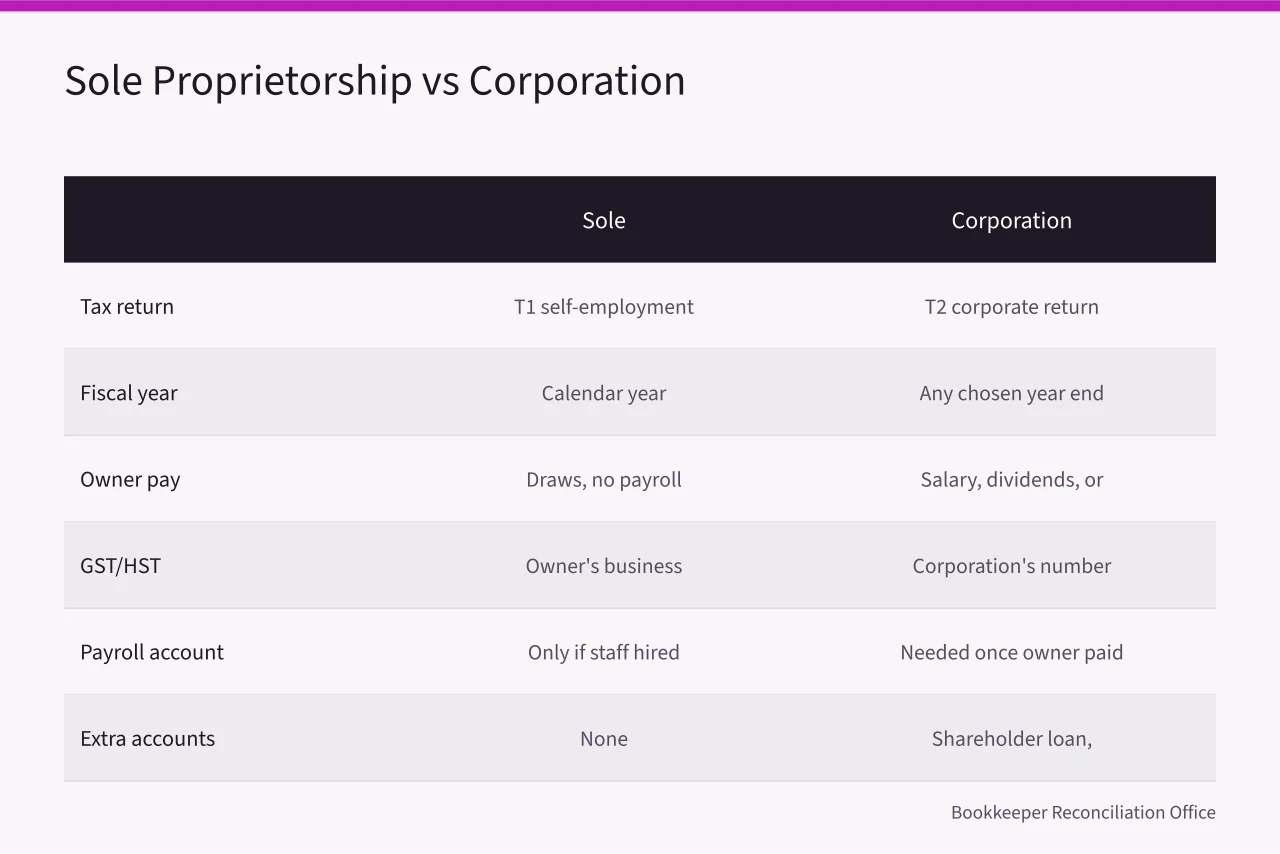
Sole proprietorship
- Income tax form
- Schedule C on Form 1040
- Tax ID
- SSN or EIN
- Year end
- Calendar year
- Owner pay
- Draws
- Payroll account
- Only if employees
- Liability
- Owner personally liable
Corporation
- Income tax form
- Form 1120 or 1120-S
- Tax ID
- EIN required
- Year end
- Any month end
- Owner pay
- Salary, dividends or both
- Payroll account
- If salary is paid
- Liability
- Limited to the entity
Where each one wins
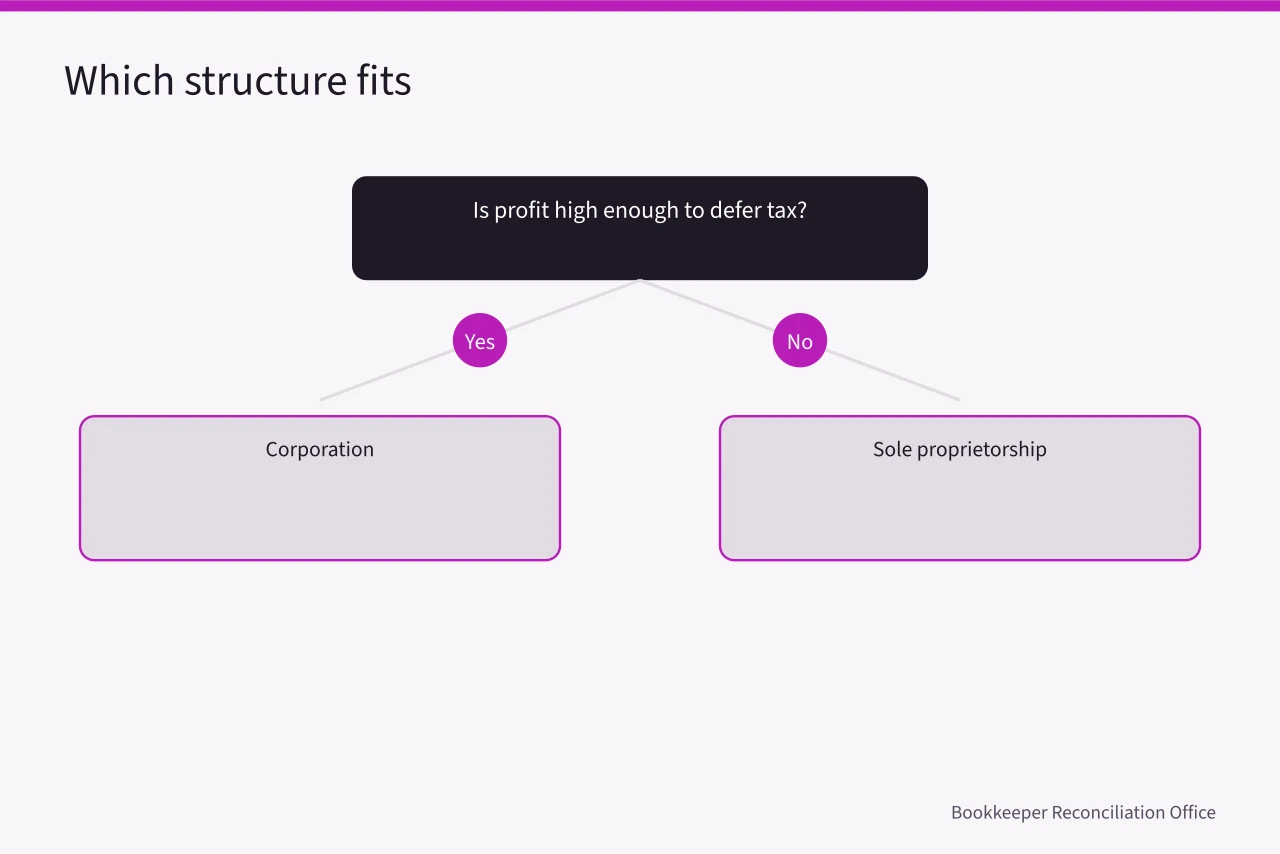
A sole proprietorship is the right answer when profit is modest, the owner is the only worker and simplicity matters more than tax deferral. One return, one set of books, no payroll account.
A corporation is the right answer when profit is high enough that leaving it in the company beats taking it personally, or when liability exposure justifies a separate legal person. It is also common once a business has employees, contracts or investors.
Neither answer is permanent. A business can incorporate later, and the books then need a transition entry that moves assets and liabilities in at fair market value. Depreciation history carries over, so read Publication 946 before you book the transfer.
Example: the same year, two files
Take a consultant billing 180,000 dollars with 40,000 dollars of expenses. As a sole proprietor, 140,000 dollars lands on Schedule C and self-employment tax applies to most of it.
Incorporated, the company pays tax on the same 140,000 dollars. If the owner takes 90,000 dollars as salary, payroll tax applies to that amount and the remaining profit stays in the company.
The bookkeeping difference is not the numbers. It is the extra accounts, the payroll register and the corporate return.
What none of them solve
Structure does not fix bad records. A corporation with unreconciled bank accounts and no expense receipts has the same problem as a sole proprietorship in the same state, plus a Form 1120 that cannot be filed cleanly.
Both structures depend on the same discipline. Bank feeds matched monthly, receipts filed against transactions, and a close that happens on a schedule rather than in a panic before a deadline. The SBA guidance on managing finances treats that routine as the baseline, not an upgrade.