
Guides
Payroll tax requirements: what to keep and what to drop
Payroll tax requirements divide into ongoing obligations you keep all year and one-time tasks you can drop after a worker leaves or a rule changes.
What to take away
Payroll tax requirements divide into two piles: obligations to keep while you have employees, and tasks to drop after a worker leaves or a rule changes. They start the moment someone becomes your employee. They run on a calendar an agency sets, not you. Nothing waits for you to notice.
- Keep federal income tax withholding, the employee and employer shares of Social Security and Medicare, and federal unemployment (FUTA) while you have employees.
- Keep your state unemployment account and state income tax withholding for the states where work is performed.
- Keep local withholding only where a city or county levies its own tax.
- Keep Form W-4, quarterly Form 941, annual Form 940, annual Form W-2 and W-3, and Form 1099-NEC for contractors paid $600 or more.
- Drop a state withholding account only after you file a final return and close the account with that state's revenue department, not when the last worker leaves.
- Drop local withholding when no employee works in that city or county.
- Drop a state unemployment account after no employees work in that state and you have filed everything owed.
- Drop employment tax records after four years, unless a state or other rule requires longer.
- The IRS publishes the federal rules. Each state's revenue department and its separate employment agency publish theirs.
- Money withheld from a worker's pay is never the business's money. That fact explains why this area is treated so seriously.
- Rates, thresholds and deposit schedules change every year. Confirm the current figure with the IRS or your state before you rely on it.
Payroll tax requirements to keep: federal, state, local
These requirements run continuously while you have at least one employee.
Federal income tax withholding. You hold back tax from each paycheck using the employee's Form W-4 and send it to the IRS. The IRS employment taxes pages carry the current rules.
Your deposit schedule comes from Publication 15 (Circular E). For 2026, employers with $50,000 or less in employment taxes during the lookback period deposit monthly. Larger employers deposit semiweekly. Form 941 is due by the last day of the month after each quarter ends: April 30, July 31, October 31, and January 31.
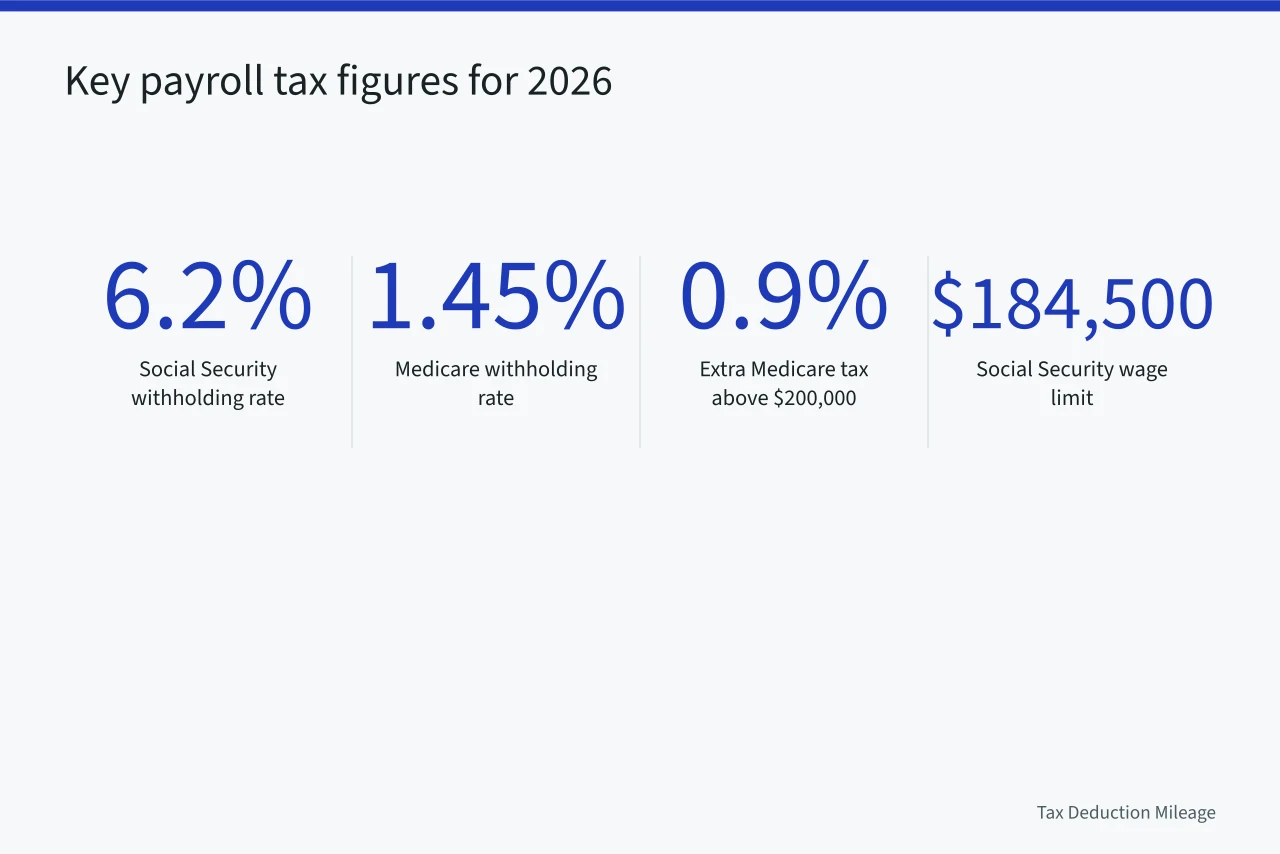
Social Security and Medicare. You withhold 6.2% for Social Security and 1.45% for Medicare. You pay an equal employer share. Social Security applies up to $184,500 of wages in 2026. Medicare has no wage limit.
An extra 0.9% Medicare tax applies above $200,000 of wages, or $250,000 for married filing jointly. Report these taxes on Form 941 each quarter.
Federal unemployment (FUTA). The employer pays this alone, reported annually on Form 940. The gross rate is 6.0% on the first $7,000 of each employee's wages. A credit of up to 5.4% usually lowers the effective rate to 0.6%, or $42 per employee per year. Employees contribute nothing. Form 940 is due January 31.
State unemployment insurance. A separate state employment or labor agency assigns your business a rate, which it can revise. New employer rates typically fall between 0.3% and 3.5% of taxable wages, but states set their own wage bases.
Those bases range from $7,000 in a few states to more than $60,000 in Washington. The rate notice arrives by mail and is easy to file unread.
State and local income tax withholding. If your state taxes income, withhold according to that state revenue department's tables. Some cities and counties levy their own income tax. Register where the work is performed, not where your office sits.
Wage statements and contractor forms. Give employees Form W-2 by January 31 and file copies with the Social Security Administration. File Form 1099-NEC for contractors paid $600 or more. Both forms are due January 31.
Payroll tax requirements you can drop
You can close an account, but only in the right order.
- State income tax withholding account.File a final return. Close the account with the state revenue department. Stopping payments without closing leaves an open account that still expects returns.
- Local withholding.Some cities and counties levy their own. Drop it only when no employee works in that jurisdiction.
- State unemployment account.Close it after you have no employees in that state and have filed everything owed. An idle account is not a closed one.
- Prior year rate notices and deposit schedules.Replace them with current figures after the year closes and you file. Keep the records that support filed returns.
- Employment tax records.You can drop them four years after the due date or payment date, whichever is later. Some states require longer, so check state rules first.
- Contractor filings.Drop a Form 1099-NEC obligation only if you did not pay a contractor $600 or more in the year.
The layers, and who writes each one
| Layer | Who publishes it | What it governs |
|---|---|---|
| Federal employment taxes | The IRS | Withholding, the employer's share, deposits, returns |
| Federal wage statements | The IRS and Social Security Administration | Form W-2, W-3, and Form 1099-NEC |
| State income tax withholding | The state department of revenue | Withholding where the work is performed |
| State unemployment insurance | A separate state employment agency | Contributions and your assigned rate |
| Local | A city or county authority, where one exists | Extra withholding in some places only |
Two things surprise people. The state layer is usually two agencies, not one, with separate registrations. The layer that applies follows where the work is physically done. One remote hire can open obligations in a state you have never visited.
Reading the federal pages without getting it wrong
The deposit and reporting side has its own pages. Your schedule comes from the rules there, not from preference.
- Check the tax year the page applies to, not the date it was last touched.
- Find the section matching what you areemployer, payer of contractors, or household employer.
- Read the conditions before the numbers. Most errors apply a correct figure to a situation it was never meant for.
- Follow one link deeper. The summary page links to the instructions that actually govern.
- Write down what you concluded and where you read it.
The classification question underneath everything
Whether a worker is an employee or a contractor is not settled by agreement. It follows from the working relationship. Getting it wrong creates obligations the business never budgeted for.
The IRS sets out the factors on its independent contractor or employee page. Read it before the first payment, not after a dispute. You can ask the IRS for a determination with Form SS-8. State agencies sometimes apply their own test, so a worker can be classified one way federally and another by a state.
How requirements change
Annual figures are reissued each year, so anything you memorized is a candidate for being wrong. Legislative changes sometimes arrive mid-year with their own effective dates. Keep every agency notice in one place, and read each within a week of arrival. The tax records and audits overview covers how long that material has to survive.
The payroll tax overview explains the process mechanics. The state layer comes from state business tax. The calendar side, including why an extension to file is not an extension to pay, is in tax deadlines. If you are still deciding how the business is structured, entity tax treatment determines whether owners are on payroll at all.
Common questions
I have one part-time worker. Does any of this apply?
Possibly all of it. Obligations generally follow the existence of an employee, not the number of hours. Ask a payroll professional before the first payment.
Can I just pay everyone as a contractor?
No. Classification follows the working relationship, and a written agreement does not settle it. Reclassification after the fact is one of the most expensive corrections in this area.
Where do I find the deposit schedule that applies to me?
On the IRS deposit and reporting pages for your filing year. It is determined by rules, not chosen. For 2026, the $50,000 lookback test sets monthly or semiweekly deposits. Confirm the current schedule with the IRS or your CPA before each quarter.
An owner takes money out of the business. Is that payroll?
It depends on how the business is treated for tax purposes. That is the first question to settle. It is a professional's answer rather than a preference.