Guides
3 IRS-ready bookkeeping tasks for US fitness studios
Three bookkeeping jobs keep a US fitness studio IRS-ready: contractor 1099 filings, self-employment tax reserves, and records that hold up at audit.
What to take away
- Pay any contractor $600 or more in a calendar year and you owe them Form 1099-NEC, with a copy to the IRS by January 31.
- Collect a Form W-9 before the first payment, not in January when the contractor has already moved on.
- Self-employment tax is 15.3 percent of net profit, and no employer withholds it for you. Quarterly estimates avoid the interest.
- A deduction survives an audit on four factswhat you bought, how much, when, and why it was business.
- Keep employment tax records and asset purchase records longer than ordinary receipts. Three years is the floor, not the rule.
Task 1: 1099 tracking for contract instructors
A studio runs on a mix of employees and contractors. Per-class instructors, guest workshop leaders and marketing freelancers usually sit in the contractor group. Cross $600 with any one of them in a calendar year and Form 1099-NEC is owed to that person and to the IRS.
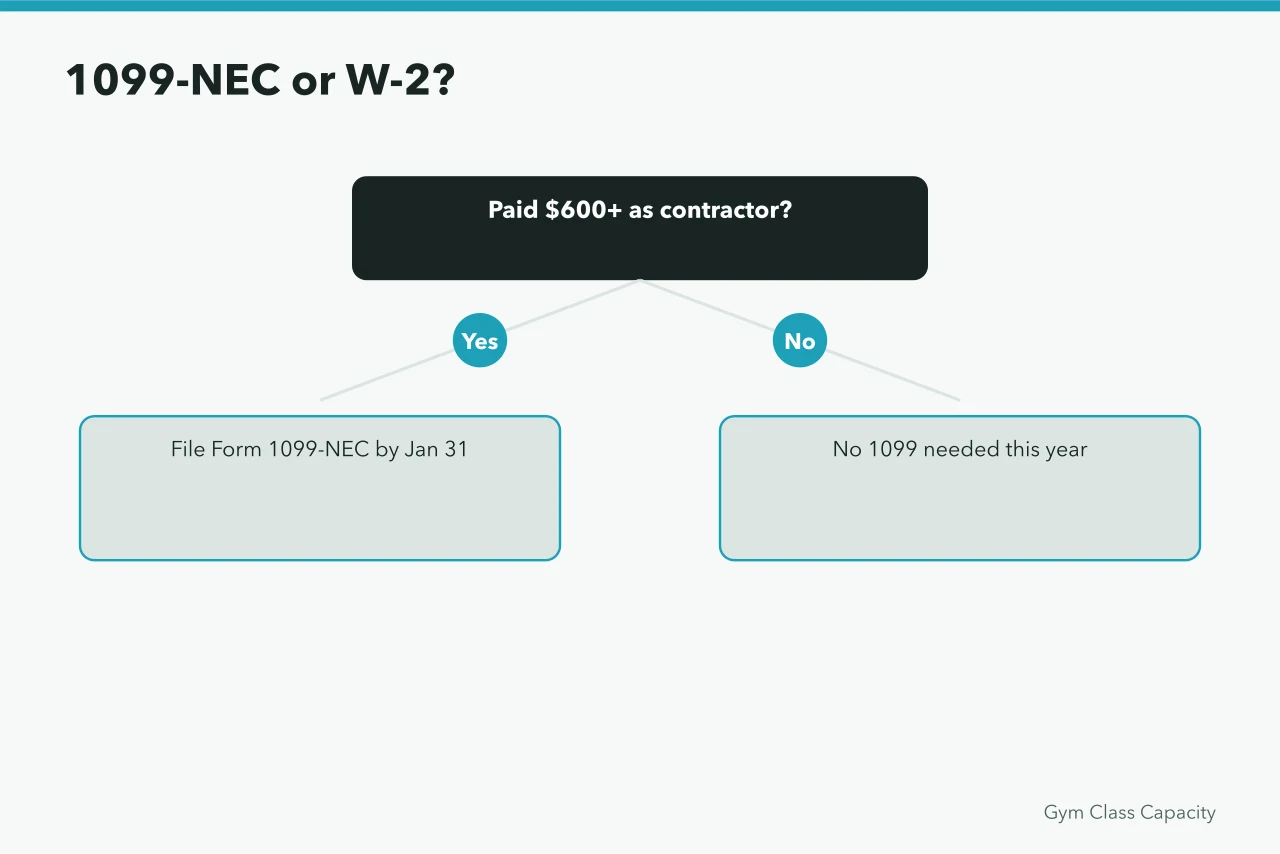
The deadline is January 31, and penalties accrue per form. That is why the work belongs in a weekly routine rather than a January panic.
Collect a W-9 before the first payment
Ask for Form W-9 before you pay anyone. It carries the legal name, address and taxpayer identification number the 1099 needs. Chasing a former instructor for a Social Security number in February is the most common failure in small studio bookkeeping.
Keep the W-9s in one folder and note each contractor's running total as the year goes. By December the totals already exist.
Who does not get a 1099
Do not issue one to a corporation paid through its corporate entity in most cases, and never to your own employees. Employee wages go on Form W-2.
An instructor you schedule, equip and supervise looks like an employee, whatever the contract says. The IRS weighs behavioral and financial control, not job titles. Misclassification brings back taxes and penalties, so take the question to a CPA or an employment attorney before you build a roster on it.
Setting up the tracking
- Get an employer identification number so contractors and the IRS see a business rather than your Social Security number.
- Have every contractor complete Form W-9 before their first payment.
- Record each payment in a vendor ledger as it happens.
- Total payments per contractor in early January and pull the current Form 1099-NEC.
- File with the IRS and deliver contractor copies by January 31.
The IRS publishes the EIN application at Get an employer identification number | Internal Revenue Service, and gathers the filing and recordkeeping pages at Businesses | Internal Revenue Service.
Worked example: three instructors, two forms
A Denver studio pays three contract instructors. One earns $4,200 across the year, one earns $1,800, and one teaches two workshops for $500.
The studio files two 1099-NEC forms and keeps the third W-9 on file to answer why no form was issued. Over-filing confuses contractors. Under-filing draws penalties. Let the $600 threshold decide.
Task 2: Self-employment tax and the quarterly reserve
Own the studio as a sole proprietor, partnership member or LLC taxed as one, and you pay self-employment tax on net profit. The rate is 15.3 percent for Social Security and Medicare, on top of income tax, with no employer withholding it for you.
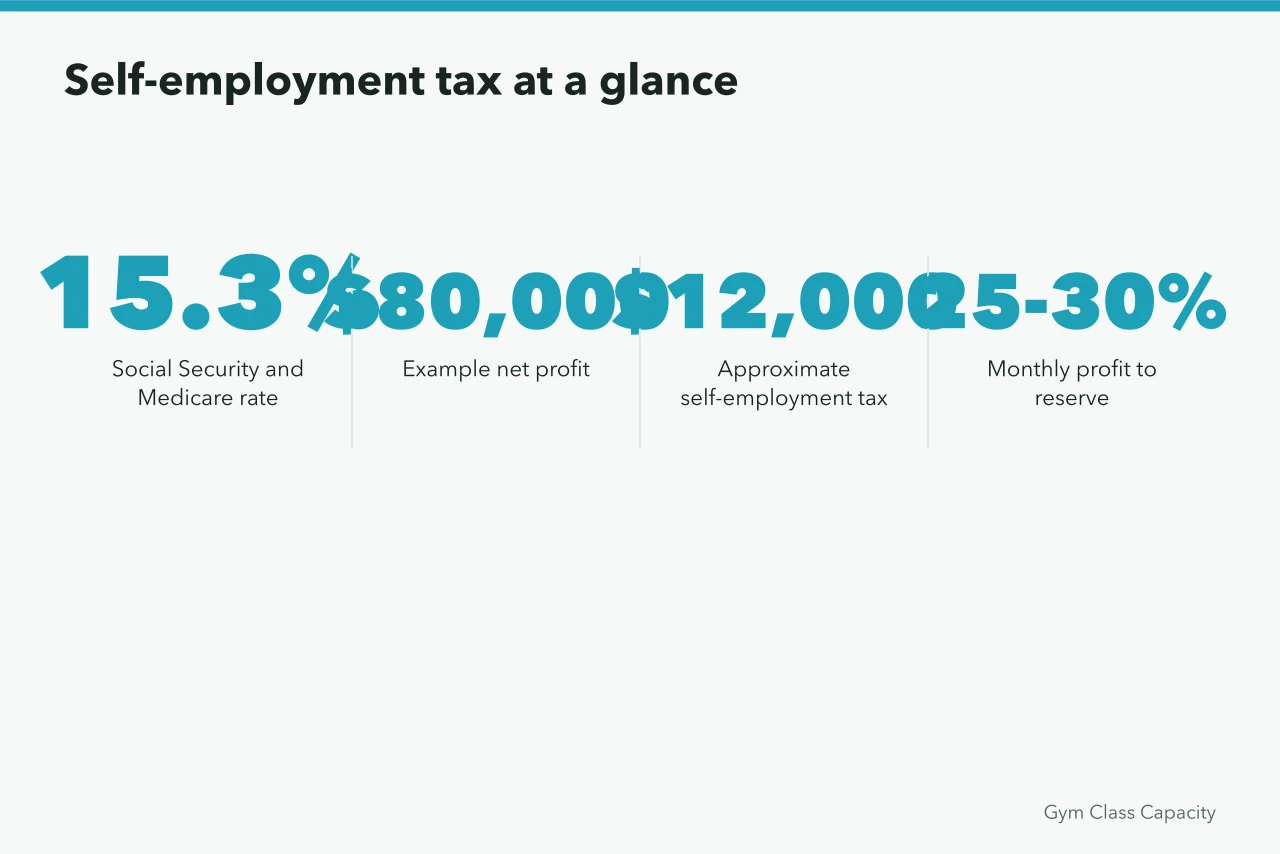
At $80,000 net profit that is roughly $12,000 before income tax starts. Owners who meet that number in April are the ones who did not reserve monthly.
The arithmetic
Gross studio revenue minus ordinary and necessary expenses gives net profit. Rent, utilities, instructor pay and equipment all count against revenue. Self-employment tax applies to what remains, and part of it is deductible against income tax.
The IRS walks through the rules in Publication 334 (2025), Tax Guide for Small Business | Internal Revenue Service. Read the self-employment tax and business deduction sections before estimating a payment.
Quarterly estimates
Most owners pay estimated tax four times a year, in April, June, September and January. Underpay and you owe interest and a penalty even when the annual return is on time.
A workable habit: each month move a fixed share of net profit into a separate tax account. Many owners start at 25 to 30 percent of profit and true up with their CPA at year end.
Before each quarterly payment
- Reconcile the business bank account for the quarter.
- Confirm net profit to date from your bookkeeping records.
- Calculate the federal estimate, self-employment tax included.
- Check state estimated tax requirements where you operate.
- Move the money to the tax account and schedule the payment.
The S corporation question
Some owners elect S corporation status to cut self-employment tax on part of their profit. The trade is payroll, a reasonable salary requirement and more filings. On modest profit the extra cost usually outweighs the saving. On strong, stable profit the math can favor it. That call belongs with a CPA, reviewed every year rather than once.
Task 3: Records that hold a deduction up
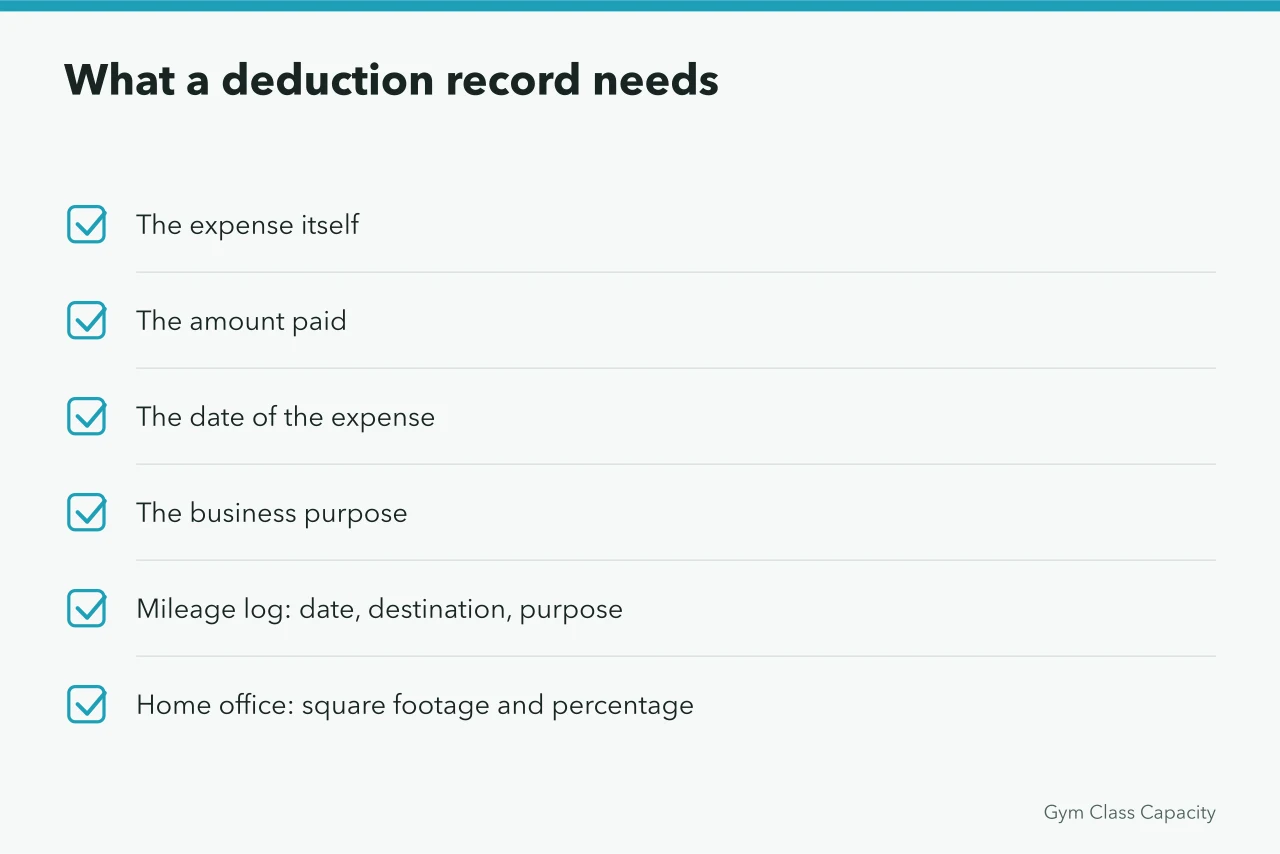
A deductible expense is an ordinary and necessary cost of running the studio. The IRS rule is broad, not unlimited. You must show the expense, the amount, the date and the business purpose.
The IRS sets out what counts and what records support it at Guide to business expense resources | Internal Revenue Service. Read the sections on rent, repairs, and mixed personal and business use.
What studios commonly deduct
- Rent, utilities and the studio's share of a shared space.
- Instructor wages, contractor payments and payroll taxes.
- Mats, mirrors, sound systems, bikes and software subscriptions.
- Liability insurance, professional memberships and continuing education.
- Marketing, website hosting and payment processing fees.
- Mileage or a share of vehicle costs for business travel.
- A home office used regularly for admin work.
Some lines are trickier. Client gifts are capped, meals have limits, and personal use of a studio vehicle or phone has to be separated out. One bank account for business and personal spending is the fastest way to lose deductions you earned.
One record per deduction
A receipt alone is not a record. Write the business purpose on it, or log it the same day. Mileage needs a log with date, destination and purpose. A home office needs square footage and the calculation behind the percentage.
Photograph paper receipts and store them by month. Digital is fine if it is readable and sorted, not a shoebox of images.
Worked example: bikes, training, a staff party
A Chicago studio spends $2,400 on spin bikes, $600 on instructor training and $300 on a staff holiday party. The bikes are equipment, generally depreciable or eligible for a small business expensing rule. The training is business education. The party may be partly deductible as a business meal depending on the facts.
Each item needs its own receipt and a purpose note. That note is what turns a pile of paper into a defensible deduction.
What the tax work does to cash flow and staffing
Bookkeeping shapes what you can pay people and when you can expand. Owners who track contractor totals and reserve self-employment tax monthly skip the spring cash crunch that closes small studios.
Knowing your true net profit after tax lets you price classes honestly. A class that looks profitable before tax can be marginal after self-employment tax and payroll. Our pricing and profit guide works through rates that survive the tax bill.
Staffing moves on the same numbers. Raise instructor pay and your 1099 totals and self-employment tax base rise with it. Check pay rates and labor costs against class revenue before adding a shift.
Still planning the build-out? startup costs and funding covers what to budget before revenue starts. A tax reserve and a recordkeeping system belong in that budget from month one.
Good records also sharpen hiring and training. You can see which instructors fill classes and train toward demand you can afford. Equipment purchases feed the same ledger, and our fitness studio equipment guide covers what to buy new and what to buy used.
Recordkeeping systems that hold up
IRS recordkeeping rules are specific rather than complicated. Keep records that support income, deductions and credits, and keep them long enough for review. Employment tax records outlive ordinary receipts.
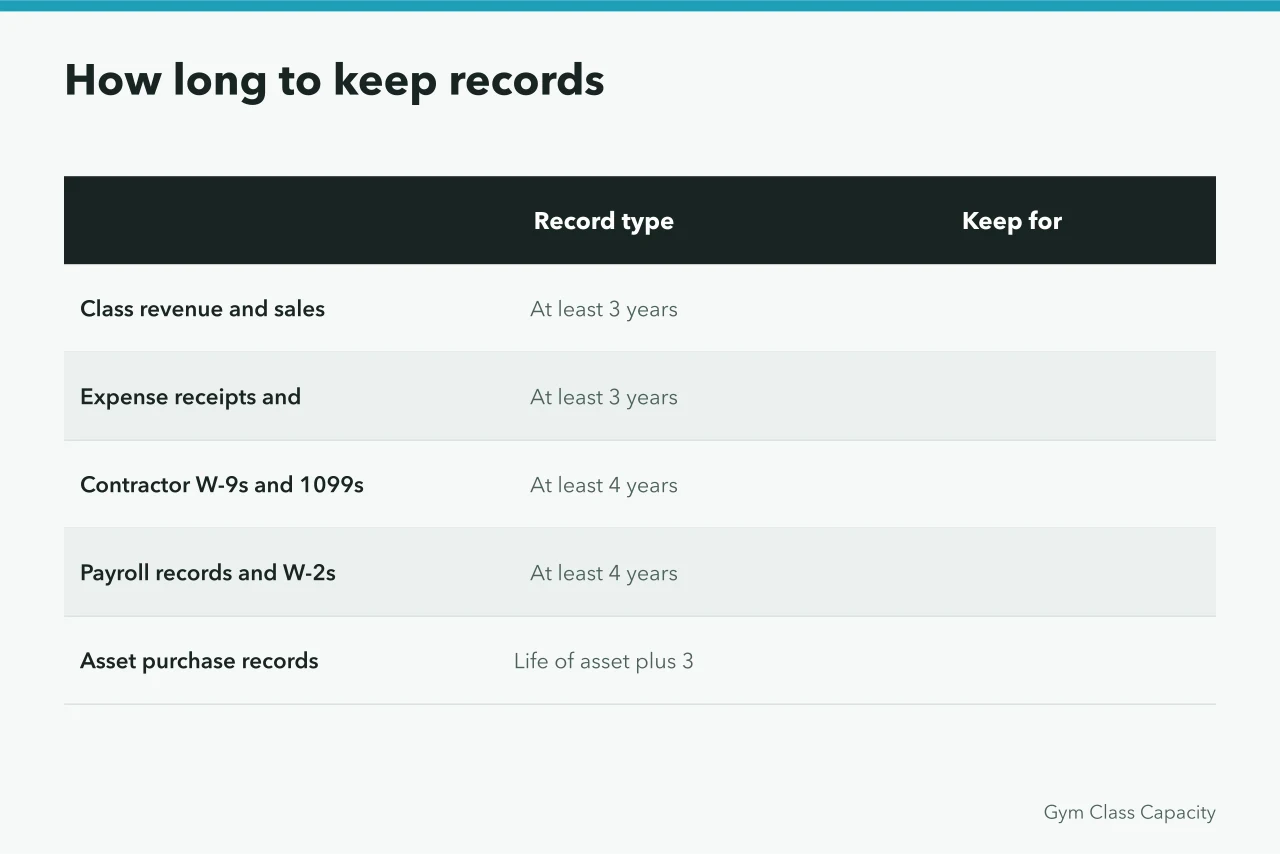
A workable system has three parts: a business bank account, a bookkeeping tool and a folder structure. Business spending runs through the business account. The tool categorizes weekly. The folders hold receipts by month and year.
What to keep, and how long
| Record type | What it supports | Keep for |
|---|---|---|
| Class revenue and sales reports | Gross income | At least 3 years |
| Expense receipts and invoices | Deductions | At least 3 years |
| Contractor W-9s and 1099s | Contractor payments | At least 4 years |
| Payroll records and W-2s | Employee wages and taxes | At least 4 years |
| Asset purchase records | Depreciation and basis | Life of asset plus 3 years |
Three years is the general window for the IRS to assess additional tax. Some situations extend it, so longer is safer. Ask your CPA which applies to your studio.
The weekly hour
Set one hour a week. Reconcile the bank account, categorize transactions, file receipts, update the contractor ledger. At quarter end, total revenue and expenses and calculate the estimate. At year end, produce a profit and loss statement, a balance sheet and a contractor payment summary. Those three documents hand your CPA almost everything needed to file.
Where owners get caught
A studio that opens without a certificate of occupancy can lose insurance coverage. Keep that document with your business records. The local fire marshal sets occupancy limits, and the state health department issues sanitation permits for saunas and pools.
OSHA injury logs and ADA accessibility records are not tax documents, but they live in the same archive. One organized system serves tax, insurance and inspection at once.
When to hand the books to a professional
Hire a bookkeeper when weekly admin starts eating class planning time, or when a mistake costs more than the service. For many studios that is around six figures in annual revenue.
A bookkeeper handles categorization, reconciliation, payroll processing and 1099 preparation. A CPA handles entity structure, S corporation elections, estimated tax strategy and the annual return. Many owners need both, at different levels of involvement.
Signs you are past doing it yourself
- You missed or nearly missed a 1099 or payroll deadline.
- You cannot state last month's net profit without digging.
- You are weighing an S corporation election.
- You hired your first W-2 employee.
- You owe estimated tax penalties two quarters running.
Start the search before tax season, because good accountants book up in January and February. Ask other studio owners for referrals and check whether the firm works with fitness businesses.
What to hand over
Give your accountant access to the bookkeeping tool, the bank statements, the contractor ledger and last year's return. Clean records shrink the bill. A CPA charging hourly spends far less time on a tidy set of books.
Common questions
Do I need an EIN as a sole proprietor with no employees?
No, you can use your Social Security number. An EIN keeps that number off contractor forms and invoices, and it is free to obtain through the IRS.
What happens if I file a 1099 late?
The IRS assesses a penalty per form, and the amount rises the later you file. Correct the filing as soon as you notice the error.
How much should I reserve for self-employment tax?
The rate is 15.3 percent of net profit, plus income tax on top. Many owners hold 25 to 30 percent of profit and adjust with their CPA.
How long do I keep studio tax records?
At least three years for most income and expense records, longer for employment tax records and asset purchases. Confirm your own situation with a CPA.